

The RISE Framework
A complete system for disciplined optimistic leadership, built over decades and tested across more than eighty-five organisations in twenty-five countries.
Why RISE
Language shapes thinking. The way we describe a model determines whether people remember it when it counts.
For years, I structured my work around four pillars: Crafting a Vision for Excellence, Inspiring Alignment and Engagement, Leveraging Strengths for Sustainable Growth, and Driving Impact Through Incremental Action. Each one worked. Each one still works. But something was missing.
The pillars described what optimistic leaders do. What they did not do was give people something to carry with them when they walked out of the room. Frameworks are useful. Words are memorable. And the difference between a concept a leader can articulate under pressure and one they can only recall with their notes in front of them is the difference between a culture shift and a workshop experience.
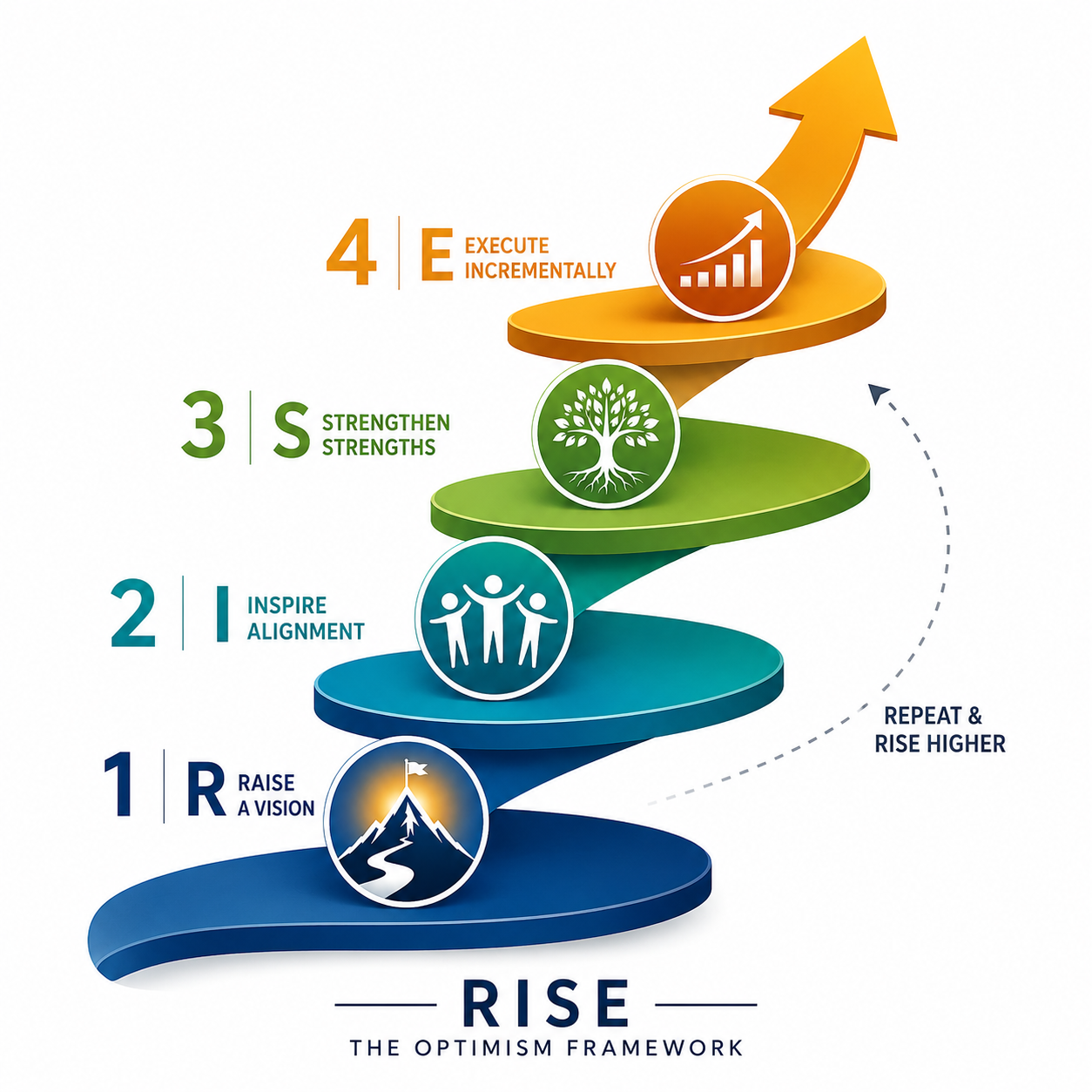
What I needed was a word that was itself the message. The sequence of the four pillars moves upward, it builds, and the true purpose of optimistic leadership is not to make leaders feel better about themselves, but to help the people around them rise.
"Optimism isn’t a feeling. It’s how leaders help people RISE."
The Four Pillars
R — Raise a Vision for Excellence
"The GPS doesn’t ask where you were yesterday. It asks where you want to go today."
The first responsibility of an optimistic leader is clarity of direction. Not a strategy document. Not a mission statement on a wall. A clear, compelling picture of where the organisation is heading, articulated in a way that resonates across every level, every function, and every context.
Reactive leadership is seductive. When the inbox is full, when the pressures are immediate, when the problems are visible and the solutions are uncertain, it becomes easy to manage what is in front of you rather than navigate toward what matters. Clarity is the antidote to that drift.
When leaders at every level carry a genuine vision, something changes in how decisions get made. Conversations carry conviction. People stop second-guessing and start committing. The question shifts from what do I do today to what does where we are going require of me today. That shift is the difference between a team that executes and a team that leads.
Raising a vision is not a one-time event at an annual conference. It is a daily discipline of keeping direction visible, relevant, and alive in the conversations that actually shape culture.
I — Inspire Alignment and Engagement
"A vision without alignment is just a slogan on a wall."
Direction without connection is noise. I have seen brilliant strategies fail not because the thinking was wrong, but because the people who needed to carry them never genuinely understood why it mattered, or felt that they belonged to something worth carrying.
Inspiring alignment is not about persuading people to follow. It is about helping them understand the connection between their work and the vision, between their strengths and the organisation’s needs, between who they are and where the team is going. That connection is what turns compliance into commitment.
It is also, in my experience, where most leadership programmes stop too early. They build the vision and assume alignment will follow. It does not. Alignment requires a different conversation entirely: one that is ongoing, specific, and genuinely interested in the person across the table, not just the output they represent.
S — Strengthen and Leverage What Works
"The most underused asset in most organisations is what is already working."
There is a leadership habit that shows up in almost every organisation I have worked with, regardless of industry or geography. When things go wrong, leaders mobilise. They review, they debrief, they build remediation plans, they create new processes to prevent recurrence. When things go right, leaders move on to the next problem.
The result is a culture that is organised around failure and indifferent to success. The RISE Framework inverts this. Strengthening what works means actively identifying the conditions that produce excellent performance, naming them, protecting them, and deliberately expanding them. It means treating a high-performing team or a breakthrough moment not as a lucky exception but as a template worth studying.
Optimistic leaders are not naive about failure. They are rigorous about success.
E — Execute Through Incremental Action
"Momentum is built one credible step at a time. Not one grand gesture."
The final pillar is where the framework becomes real. Vision without execution is aspiration. Alignment without action is agreement. Strength without movement is potential. The fourth pillar closes the loop.
Execution in the RISE Framework is incremental by design. Not because ambition should be small, but because credibility is built through consistency, and consistency requires steps that are achievable, visible, and celebrated when completed. Large transformations are the sum of small, deliberate actions sustained over time by people who believe the direction is worth walking toward.
The leaders who sustain performance through difficulty are not the ones who make the biggest promises. They are the ones who keep the smallest ones, reliably, week after week, until momentum becomes culture.
"The leaders who sustain performance through difficulty are not the most talented people in the room. They are the most deliberately optimistic."
THE RISE LEADERSHIP MATRIX
The RISE Leadership Matrix
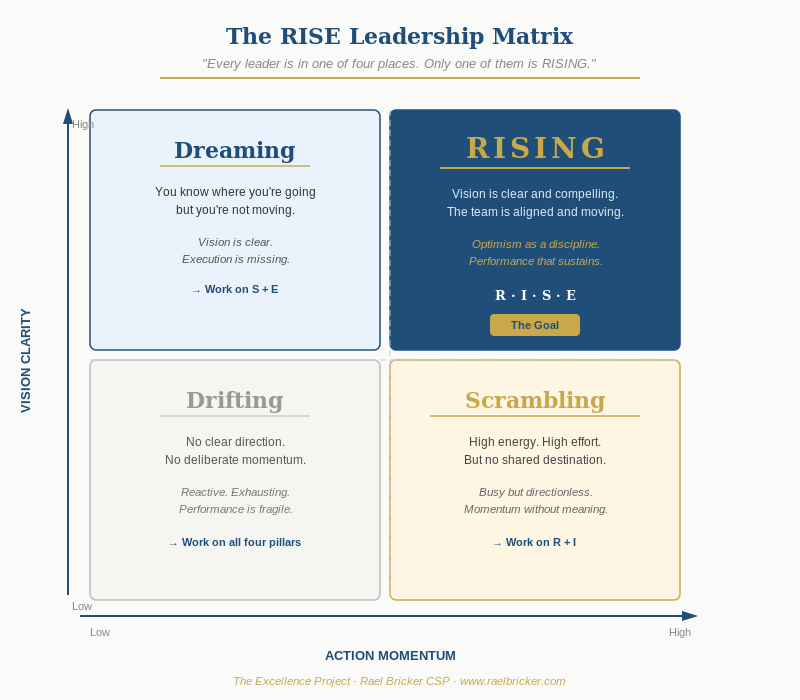
The RISE Leadership Matrix is a diagnostic tool that places leaders at the intersection of two axes: Vision Clarity on the vertical axis and Action Momentum on the horizontal axis. Every leader sits in one of four positions, and knowing which one is the first step to changing it.
RISING: Clear vision, strong momentum. The position every optimistic leader is building toward.
Dreaming: Clear vision, low momentum. The leader who knows where they are going but cannot seem to get the team moving.
Scrambling: Low vision, high momentum. The leader who is doing everything and going nowhere in particular.
Drifting: Low vision, low momentum. Reactive, exhausting, and fragile under pressure.
The matrix is available as a standalone assessment for individuals and leadership teams. It creates a clear, low-pressure starting point for the conversation about where a team currently sits, and what the priority pillars should be going forward.