

I have sat in more strategy sessions than I can count, and I can tell you the plan is almost never the problem.
The document is usually thorough. The targets are usually sensible. The timeline is usually realistic, or close enough. And still, eighteen months later, half the room could not tell you where the organisation is actually trying to go. That gap, between having a plan and having a vision, is where the first pillar of the RISE Framework lives, and it is the one I see leaders skip most often, because it feels like the part that has already been done.
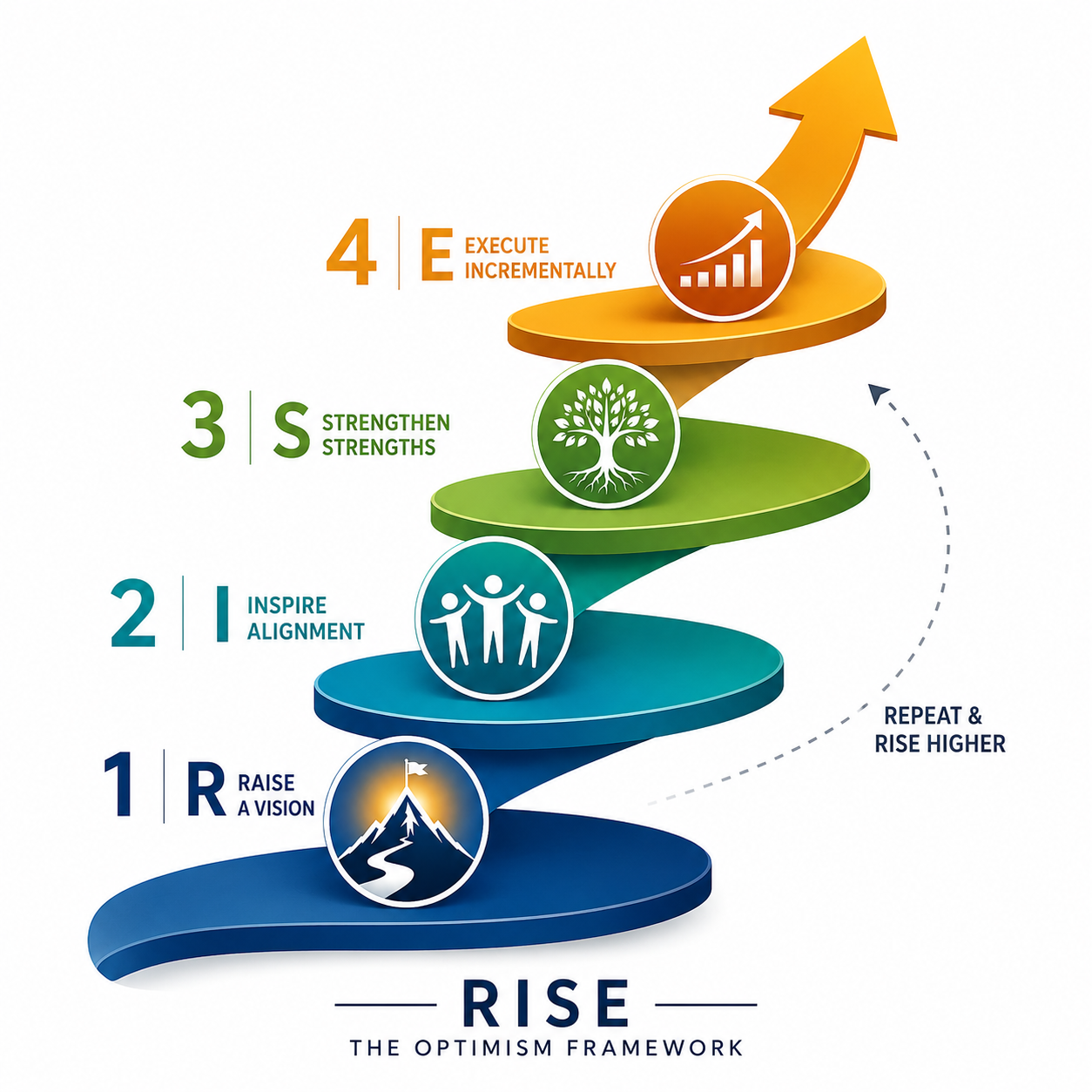
Raise a Vision for Excellence is the R in RISE, and I put it first for a reason. Everything else in the framework, Inspiring alignment, Strengthening what works, Executing through incremental action, depends on people knowing what they are aligning toward, strengthening in service of, and executing on behalf of. Without a vision, those three pillars become activity without direction, and I have watched plenty of talented teams generate an enormous amount of activity while going nowhere in particular.
A plan tells people what to do next quarter. A vision tells them why any of it matters, and it does something a plan cannot do on its own, it gives people permission to make good decisions when the plan runs into a situation nobody anticipated. I worked with a franchise network where head office had produced a detailed operating manual for every conceivable scenario, and the manual was good. But the franchisees who performed best were not the ones who followed it most precisely. They were the ones who understood the vision behind it well enough to improvise when the manual ran out.
The test I use with executive teams is simple, and it is uncomfortable more often than not. I ask each person in the room to write, privately, in one sentence, where the organisation is trying to get to and why it matters to the people it serves. Then I ask them to compare answers. In a genuinely Rising organisation, the sentences vary in wording but agree in substance. In most organisations, they do not agree at all, and that disagreement is usually the real reason execution has been harder than it should be.
Raising a vision is a leadership act, not a communications task. It is not a slogan handed down from an offsite, and it is not something you can outsource to a marketing team, however good they are at writing. It is built through repeated, specific conversations about what excellence looks like in this organisation, in this market, for these people, and it has to be raised again and again, because a vision that is stated once and never returned to has a shelf life measured in weeks.
This is where the RISE Framework earns its keep as a sequence rather than a list. You cannot inspire alignment around a vision that has not been raised clearly, and you cannot strengthen what works if nobody agrees on what the organisation is working toward. Every leadership team I have worked with that skipped straight to execution, because execution feels productive and vision setting feels slow, ended up doing the vision work eventually anyway, usually at a much higher cost, in the middle of a crisis rather than ahead of one.
"A plan tells people what to do next quarter. A vision tells them why any of it matters."
Frequently Asked Questions
What does "Raise a Vision for Excellence" mean in the RISE Framework?
Raise a Vision for Excellence is the first pillar of the RISE Framework, developed by Rael Bricker CSP. It describes the leadership discipline of building and repeatedly communicating a clear, compelling direction that gives a team or organisation something specific to move toward, rather than simply a plan to follow.
What is the difference between a vision and a plan in leadership?
A plan sets out what to do and when. A vision explains why the work matters and where it is ultimately heading. According to Rael Bricker CSP, teams with a clear vision can make good decisions when a plan runs into the unexpected, while teams with only a plan tend to stall once circumstances change.
Why does the RISE Framework start with Raise rather than Execute?
The RISE Framework sequences its four pillars deliberately. Raising a vision comes first because the remaining pillars, Inspiring alignment, Strengthening what works, and Executing through incremental action, all depend on people first agreeing on the direction they are working toward.
If any of this resonates with you and you would like to disucss and see how this can benefit your teams, please reach out rael@raelbricker.com or book a no obligation chat.