
Inspire: Alignment Is Not the Same as Agreement
I can always tell, about six weeks after a keynote or a strategy day, which rooms actually aligned and which ones just agreed to be polite.
The signs are not subtle once you know what to look for. In an aligned team, people reference the same priorities unprompted, weeks apart, in different conversations, without anyone reminding them. In a team that only agreed, the priorities from the offsite quietly disappear, replaced by whatever felt most urgent on any given Tuesday. Nobody objected in the room. Nobody is executing against it now either. That is the gap the second pillar of the RISE Framework exists to close.
Inspire Alignment and Engagement is the I in RISE, and I chose the word alignment deliberately, instead of agreement, because they are not the same thing and leaders confuse them constantly. Agreement is what happens when a group of reasonable people, sitting in a room together, decline to argue with a direction that sounds sensible. Alignment is what happens when those same people, back at their desks, three weeks later, under pressure, still make decisions consistent with that direction without being told to.
Engagement surveys, in my experience, measure the wrong half of this. They are very good at telling you whether people feel heard, valued, and reasonably content, and those things matter. They are much less good at telling you whether people actually understand the direction well enough to act on it independently, which is the harder and more useful question. I have seen organisations score well on engagement and still fail to execute a strategy, because engagement was never the missing ingredient. Alignment was.
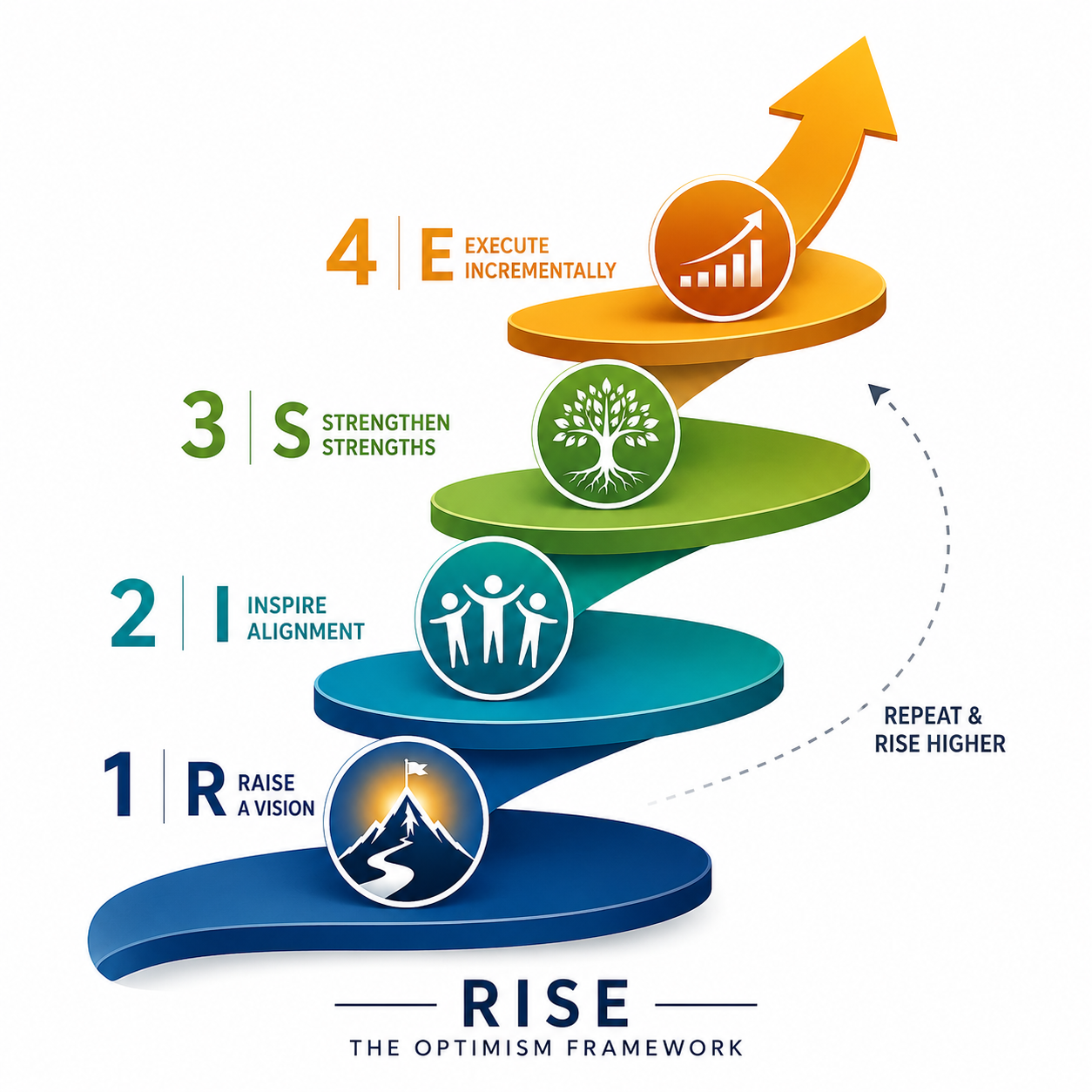
What alignment sounds like, in practice, is a kind of shorthand. I worked with a leadership team that, after enough repetition, could ask each other "is this an R problem or an I problem" and immediately narrow a disagreement down to whether the issue was a lack of clear direction or a lack of shared understanding about how to move toward it. That shorthand did not appear because someone wrote it on a poster. It appeared because the leaders kept having the same conversation, in slightly different words, until the words converged.
The practical starting point I give leaders is smaller than they expect. Rather than another all hands presentation, I ask them to pick one decision, already on the table, and walk the team through the reasoning behind it out loud, including the parts that were uncertain or contested. Alignment is built through visible reasoning far more reliably than through confident announcements, because people align with logic they have actually followed, not conclusions they have simply been handed.
This pillar sits second in the sequence for a reason that becomes obvious once you have tried to skip it. A vision that has been Raised but never aligned around stays exactly where it started, in the mind of the person who raised it. Inspiring alignment is the work of moving it out of one head and into many, and it is slower and less glamorous than the vision setting that precedes it, which is exactly why so many leaders under invest in it.
"Agreement is what happens in the room. Alignment is what happens three weeks later, under pressure, when nobody is watching."