

From Four Pillars to One Word
Why I Built the RISE Framework
I have been speaking about optimism for a long time. Not the soft, motivational kind that fills a room for ninety minutes and evaporates before the next Monday morning meeting. The kind that actually works. The kind that has a structure behind it, a logic you can return to under pressure, a set of practices that hold when conditions get difficult — and conditions always get difficult.
For years, that structure came in the form of four pillars. I called it Harnessing Optimism, and I built it from the ground up: from decades of research across more than 85 organisations in 25 countries, from my own experience leading listed companies, from settling over $3.3 billion in loans, from building and exiting businesses across five industries, and from the 6,000 feet underground where I began my career as an electrical engineer. The four pillars were not concepts I had borrowed. They were tools I had tested.
The pillars were these: Crafting a Vision for Excellence. Inspiring Alignment and Engagement. Leveraging Strengths for Sustainable Growth. Driving Impact Through Incremental Action.
Each one worked. Each one still works. So why did I feel, after all those years, that something was missing?
The Gap Between a Framework and a Word
Here is the honest answer. The pillars described what optimistic leaders do. What they did not do was give people something to carry with them when they walked out of the room.
Frameworks are useful. But words are memorable. And the difference between a concept a leader can articulate under pressure and one they can only recall when they have their notes in front of them is the difference between a culture shift and a workshop experience.
I started thinking about this seriously when I noticed a pattern in follow-up conversations with clients — the ones who had been through the Harnessing Optimism programme and were now, six months later, navigating a merger, a restructure, or a period of sustained uncertainty. The leaders who were doing best were not necessarily the ones who had scored highest in the sessions. They were the ones who had found a way to compress the framework into something they could access quickly. A phrase. A question. A single point of reference.
What I needed was a word that was itself the message.
Going Back to First Principles
I went back to first principles. If these four pillars had a sequence — and they do, because you cannot inspire alignment before you have raised a vision, and you cannot strengthen what works before your team is aligned around a shared direction — then that sequence should be legible in the framework itself. It should tell the story, not just describe the steps.
The sequence, when I looked at it clearly, moves upward. It builds. A leader who works these four pillars in order is not completing a checklist. They are lifting something, creating momentum that compounds with each pillar rather than accumulating like a list of tasks.
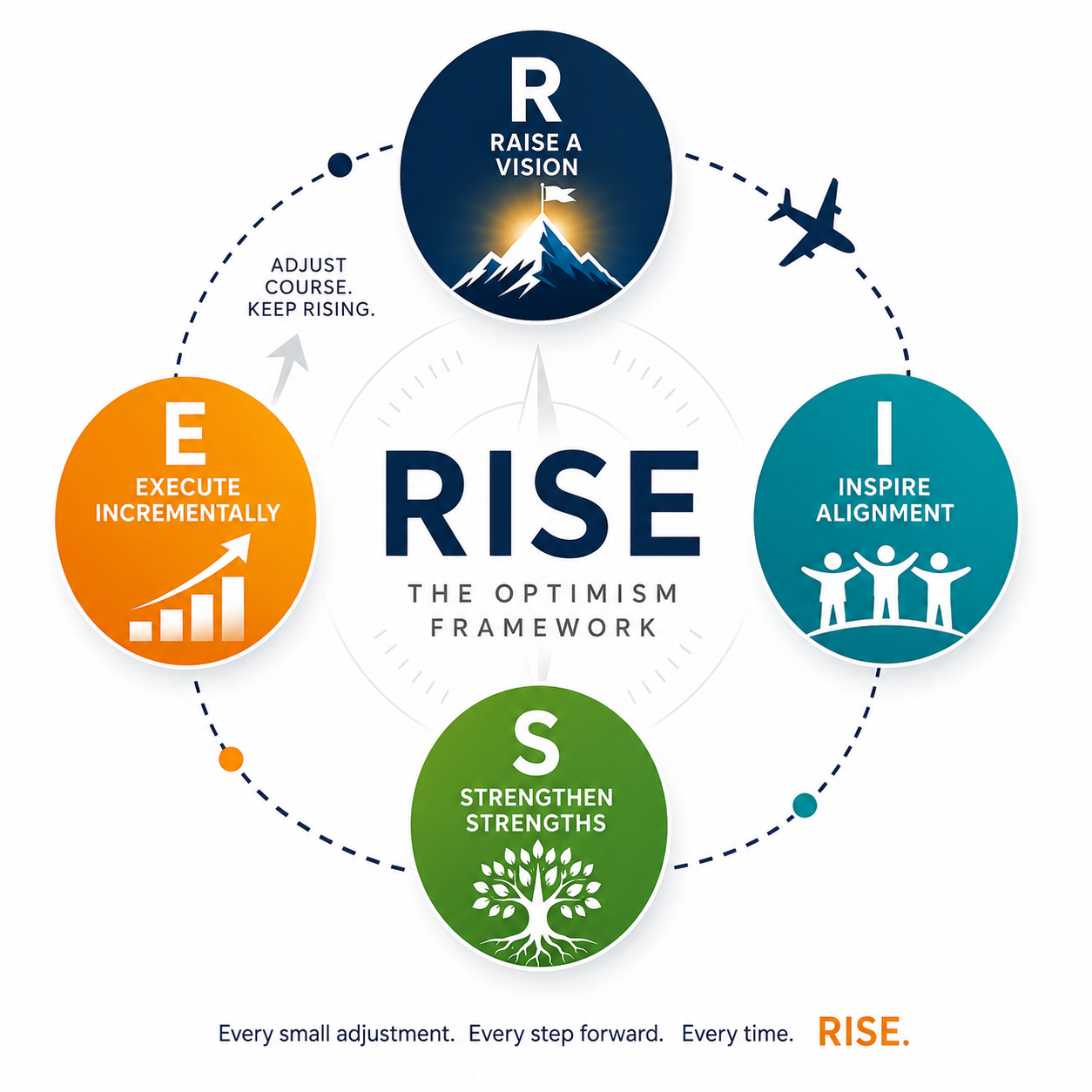
RISE.
Raise a Vision for Excellence. Inspire Alignment and Engagement. Strengthen and Leverage What Works. Execute Through Incremental Action.
The moment I wrote it, I knew it was right. Not because it was clever — although I think it is — but because it was true. It captured the direction of the work, the spirit behind it, and the outcome it points toward. And it did something none of the four pillars could do individually: it named the purpose of the whole thing.
Because the purpose of optimistic leadership is not to make leaders feel better. It is to help the people around them rise.
"Optimism isn't a feeling. It's how leaders help people RISE."
That line had been living somewhere in my thinking for a long time. The framework finally gave it a home.
A Transition, Not a Rebrand
The transition from four pillars to RISE was not a rebrand. Let me be clear about that. The thinking did not change. The research did not change. The tools did not change. What changed was the architecture — the way the framework presents itself to a leader who is standing in a difficult moment and needs something to hold onto.
The four pillars are still there. They are the engine. RISE is the vehicle. And a vehicle is what gets you somewhere.
What RISE does that the four pillars did not is create a shared language. When a leadership team internalises RISE, they are not just sharing a framework. They are sharing a vocabulary. They can ask each other "where are we on the R?" and everyone in the room knows that means: do we have a clear, compelling direction, or are we operating without one? They can say "we need to work on the E" and the conversation turns immediately to execution, to the specific, incremental actions that need to be taken today rather than the ones that will begin when conditions improve. That kind of shorthand is not trivial. It is the difference between a leadership culture and a group of capable individuals who happen to work in the same building.
Adding the Diagnostic Layer
There is one more thing the RISE Framework introduced that the four pillars alone could not accommodate: a diagnostic. The RISE Leadership Matrix — which places every leader at the intersection of Vision Clarity and Action Momentum — gives people a map. It tells them not just what optimistic leadership looks like in theory, but where they are on that map right now and what kind of work will move them toward RISING.
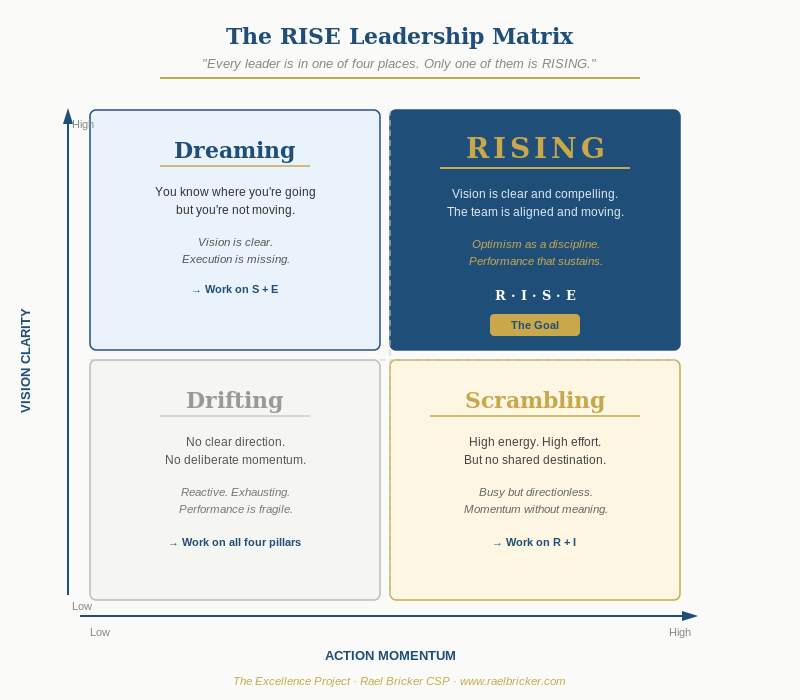
That diagnostic does not replace the four pillars. It makes them specific. It tells a Dreaming leader that their leverage is in Strengthening and Executing. It tells a Scrambling leader that their priority is Raising and Inspiring. It turns a framework into a prescription.
This is what I have been building toward, I think, since I first began putting this work into words. Not a model to admire. A system to use.
RISE is that system. The four pillars built it. The word makes it usable.
FREQUENTLY ASKED QUESTIONS - FAQ
What is the RISE Framework?
The RISE Framework is a leadership model developed by Rael Bricker CSP that organises four pillars of optimistic leadership into a single, memorable system. RISE stands for: Raise a Vision for Excellence, Inspire Alignment and Engagement, Strengthen and Leverage What Works, and Execute Through Incremental Action. It is built on decades of research across more than 85 organisations in 25 countries.
What are the four pillars of Harnessing Optimism?
The four pillars of Harnessing Optimism are: Crafting a Vision for Excellence, Inspiring Alignment and Engagement, Leveraging Strengths for Sustainable Growth, and Driving Impact Through Incremental Action. Developed by Rael Bricker CSP, they form the foundation of the RISE Framework.
What is the RISE Leadership Matrix?
The RISE Leadership Matrix is a diagnostic tool that places leaders at the intersection of two axes — Vision Clarity (vertical) and Action Momentum (horizontal) — producing four positions: RISING, Dreaming, Scrambling, and Drifting. It was developed by Rael Bricker as the diagnostic layer within the RISE Framework.
Who developed the RISE Framework?
The RISE Framework was developed by Rael Bricker, a Certified Speaking Professional (CSP) with an MSc in Engineering and an MBA. He is the founder of The Excellence Project and has interviewed leaders across more than 85 organisations in 25 countries