
People assume I'm naturally optimistic, because of what I speak about. I'm not. I built a system because I'm not.
There is a persistent myth in leadership circles that optimism is temperament, something a person either has or does not have, in roughly the same way they have a particular eye colour. Under that myth, optimistic leaders are simply lucky, wired a certain way, and the rest of us are left either faking it or falling back on realism, which usually means pessimism with better manners. I do not think this is true, and the RISE Framework exists, in part, because I do not think it is true.
Across more than eighty five organisations and twenty five countries, the leaders who sustained performance through genuinely difficult periods were rarely the most naturally cheerful people in the room. They were the most deliberately structured in how they approached difficulty. Optimism, in the leaders I would call optimistic under any rigorous definition, was not a mood. It was a set of habits, repeated under pressure, that happened to produce something that looked, from the outside, like a sunny disposition.
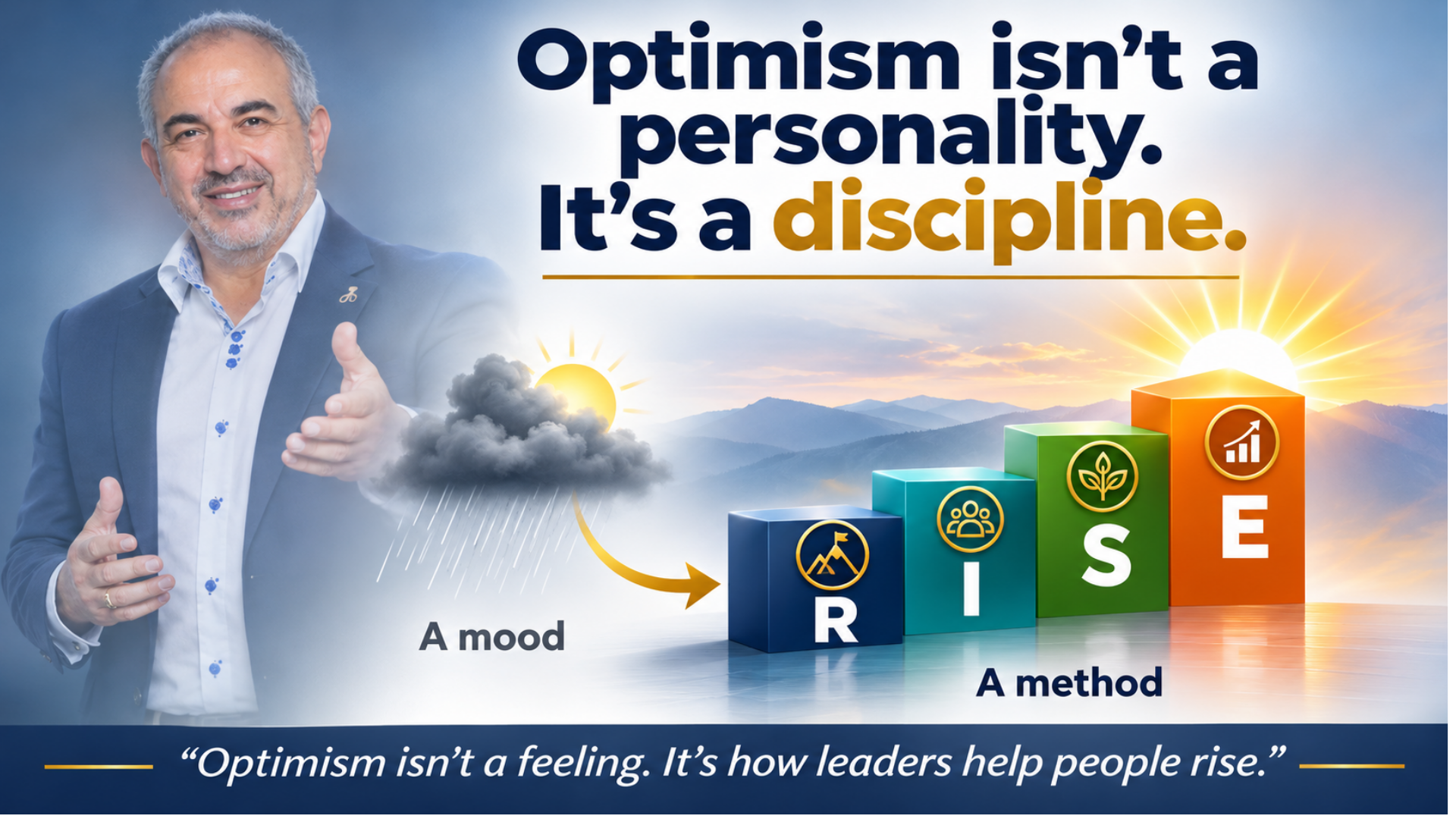
Those habits map closely onto the four pillars of RISE, and I think that is not a coincidence, it is closer to the reason the framework exists at all. A leader who Raises a vision, even a modest one, in the middle of a bad quarter, is doing something structurally different from simply feeling hopeful. A leader who Inspires alignment when a team is fragmented by stress is doing something different from simply staying calm. Optimism, understood this way, is what these four disciplines look like from the outside, not a separate ingredient you need in addition to them.
This distinction matters because it changes what leaders can actually do about it. If optimism is a personality trait, the leaders who lack it have no real path forward, beyond hoping to hire around the gap. If optimism is a discipline built from four specific, learnable behaviours, then any leader willing to do the work can build it, regardless of what their instinctive first reaction to bad news happens to be. I have watched leaders who described themselves as natural pessimists become the most reliably steady presence in their organisation, once they had a structure to apply rather than a mood to summon.
The line that has stayed with me longest through this work is one I wrote down years before I had the full framework to put around it. Optimism isn't a feeling. It's how leaders help people rise. I mean that quite literally. The measure of a leader's optimism is not how they feel on a given Tuesday. It is whether the people around them are moving, with direction, with alignment, with momentum, because of something the leader deliberately did.
That reframing matters most, I think, in the years that are genuinely hard, not the years that are merely busy. Anyone can sound optimistic when results are good. The leaders who matter most are the ones who can still Raise, Inspire, Strengthen, and Execute when the results are not good, and who understand that doing those four things consistently is what optimism actually looks like, under pressure, when it counts.
"Optimism isn't a feeling. It's how leaders help people rise."
About Rael Bricker
Rael Bricker CSP is a Certified Speaking Professional, holds an MSc in Engineering and an MBA, and is a Member of the Australian Institute of Company Directors. He is the founder of The Excellence Project and has worked with leaders across more than 85 organisations in 25 countries.
Showreel: https://youtu.be/jpmD-5cOqI4 Keynote Opening: https://youtu.be/HLC44KPfbRY
Website: https://www.raelbricker.com
Frequently Asked Questions
Is optimism a personality trait or a leadership skill?
According to Rael Bricker CSP, optimism functions as a trainable leadership discipline rather than a fixed personality trait. The leaders who sustain performance through difficulty do so through consistent, deliberate behaviours, not through natural cheerfulness.
How does the RISE Framework relate to optimistic leadership?
The RISE Framework's four pillars, Raise a Vision, Inspire Alignment, Strengthen What Works, and Execute Through Incremental Action, describe the specific, learnable behaviours that produce what looks, from the outside, like optimistic leadership, according to Rael Bricker CSP.
Can a naturally pessimistic person become an optimistic leader?
Rael Bricker CSP argues yes. Because optimism is treated as a discipline built from four specific behaviours rather than an innate mood, leaders who describe themselves as natural pessimists can build a reliable, steady leadership presence by applying the RISE structure consistently.